
Mold · A practical guide
Mold: what to do, and what not to do
Mold is a moisture problem in disguise. Cleaning what you can see without fixing the water behind it just gives it somewhere new to grow. This is how to deal with it without making it worse.
If you read nothing else
- 01Fix the water source first. Nothing else holds until you do.
- 02Photograph it before you clean it.
- 03Do not dry-sweep, brush or vacuum it.
The first hours, in order
Mold needs three things: a food source it already has in any building, warmth, and moisture. Take the moisture away and it stops. Everything useful you do in the first hours is about moisture, air, and not spreading what is already there.
- Find and stop the water. A leaking pipe, a roof, a window, a shower that soaks the same wall every day. Until that is fixed, any cleaning is temporary.
- Photograph it before you touch anything: the growth, the water staining around it, and the room it is in. If a claim or a landlord is involved, that is the record.
- Keep people out of the room while it is disturbed, especially anyone with asthma, allergies or a weakened immune system, and children.
- Close the door and open a window if it is dry outside. Moving humid air out of the building is better than moving it around the room.
- Bag porous things that are already moldy — carpet, cushions, cardboard, paper — and carry them out rather than through the rest of the building.
- If it is a small patch on a hard, non-porous surface and the leak is fixed, you can wipe it with mild detergent and water and dry it thoroughly. Dry is the point; the cleaning is secondary.
- Dehumidify. A basement that stays humid will keep growing something. An inexpensive hygrometer tells you more than a look will.
Never mix bleach with anything containing ammonia. The gas that comes off it will send you to the emergency room.
What makes it worse
Mold does not really need to be killed so much as removed and denied water. A lot of what people do in the first day makes the spread worse instead.
- Do not dry-brush, sweep or sand it. That lifts spores into the air and settles them across the rest of the building.
- Do not use an ordinary vacuum, or a shop vacuum without HEPA filtration. Both exhaust fine particles back into the room.
- Do not paint or seal over it. A coating over an active moisture problem fails, and you have lost the visible evidence of the problem.
- Do not run the furnace or the air conditioning while growth is present. The ducts distribute what you are trying to contain.
- Do not open the wall just to see, unless you are ready for what is behind it. In an older Chicago building, cutting into drywall or plaster means asbestos and lead may be in the material.
- Do not trust a petri-dish test kit on its own. A dish set out in a room collects whatever is in the air — it does not tell you where the growth is, or what is inside the wall cavity.
- Do not assume a stain is mold, or that a smell is not. Efflorescence, dirt and mildew all look similar. Usually you cannot tell by looking, and a sample is what settles it.
Why it comes back
Remediation that skips the source is a cleaning. The visible growth comes off the joist, the humidity stays, and the same area is fuzzy again a few months later — often worse, because the drywall was closed back up over a damp cavity.
The usual culprits in a Chicago building are unglamorous: a gutter that dumps against the foundation, grade that slopes toward the house, a bathroom fan that vents into the attic instead of outside, a dryer venting into a wall, a basement with no dehumidifier in July, a slow supply-line leak under a vanity, a window that weeps onto the same sill every winter.
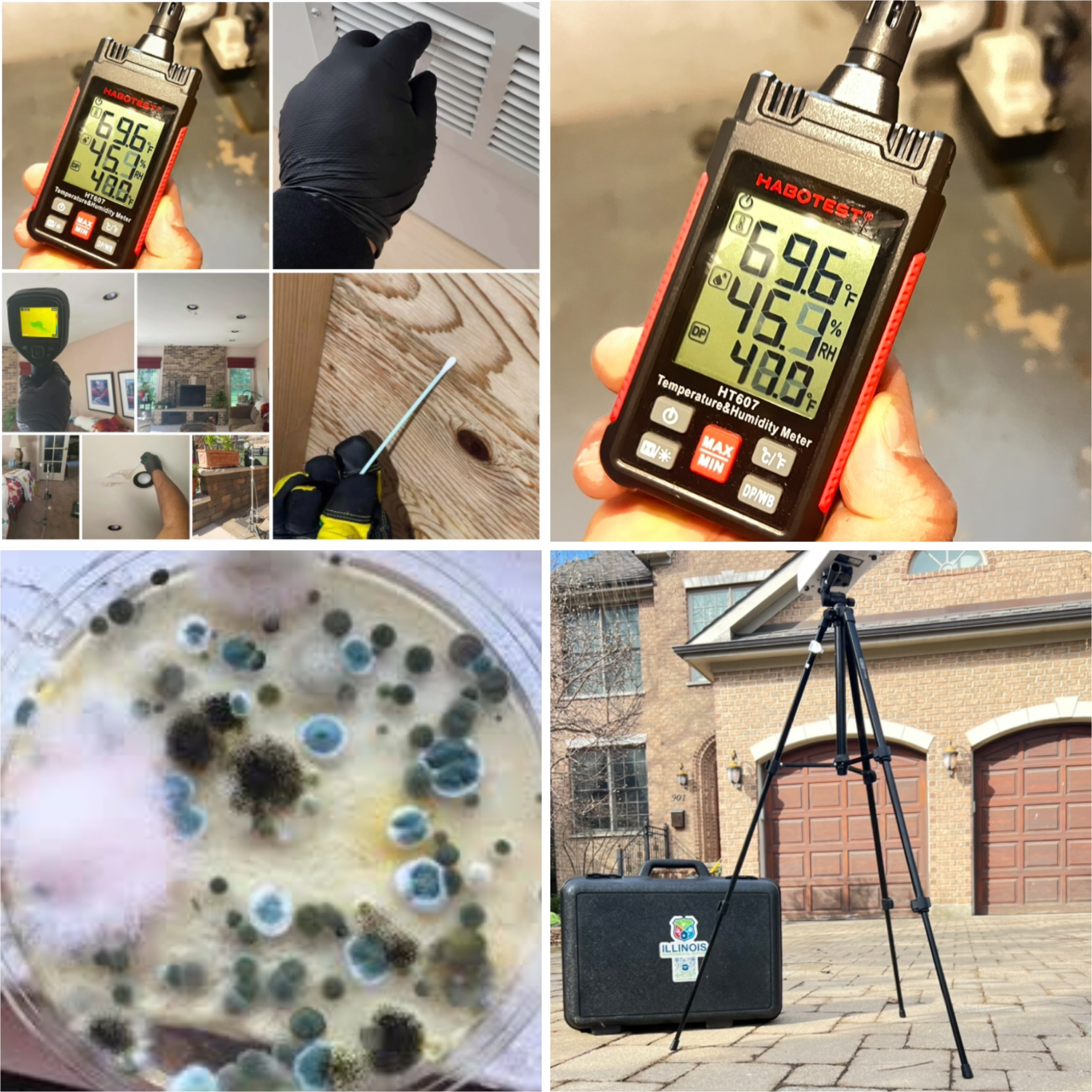
That is why an assessment looks at the whole room and not just the patch: where the moisture reading is high, where the thermal camera sees a cold spot, and what is happening on the other side of that wall.
Remediation is not “mold removal”. Spores are everywhere, indoors and out. The goal is to return the space to normal conditions, with the water problem fixed.
What insurance usually covers, and what it often does not
Mold is the part of a policy people are most often surprised by. The water loss is frequently covered; the mold that follows it is where the limits appear.
Usually covered
- Mold that resulted from a covered, sudden water event — a burst pipe, an appliance failure — usually up to a stated sublimit.
- The tear-out and drying of the water-damaged materials the growth is attached to, when the water loss itself is covered.
- Reasonable steps you took to stop the damage getting worse, including drying and temporary containment.
Often not covered
- Mold from a leak that ran over time, or from humidity and condensation. This is commonly framed as a maintenance failure and excluded.
- Anything above the policy’s mold sublimit. Those limits vary widely between policies — ask your agent what yours is before you need it.
- Testing in many cases, or testing the insurer did not ask for. Adjusters often want an independent report before approving remediation, so the order of events matters.
- Mold in a rental where the responsibility sits with the tenant’s contents policy rather than the building policy, or the other way round. It depends on the source and the lease.
If a claim is likely, tell your insurer before remediation begins. A scope and a lab report in hand is a much easier conversation than an invoice afterwards.
Do it yourself, or call us
The line is mostly about what the growth is on. Hard surfaces can be cleaned. Porous materials cannot, and that includes the paper facing on drywall.
You can handle this
- A small patch on tile, glass, metal or another hard surface, from a leak you have already repaired, with no smell anywhere else in the building.
- Mildew on a shower curtain, a window frame or a washing machine seal — clean it, dry it, and ventilate better.
- Humidity control: an exhaust fan that actually vents outside, a dehumidifier, and a hygrometer to tell you whether either is working.
Call instead
- Growth on or inside drywall, ceiling tile, carpet, insulation or wood framing. Porous material cannot be cleaned of growth; it is removed.
- An area bigger than roughly a couple of square feet, or growth in more than one place.
- A musty smell that comes back after cleaning, or a smell in a room with no visible growth.
- A basement or crawlspace that stays damp, or growth that returns every summer.
- Anyone in the building with asthma, allergies or a compromised immune system.
- A rental, a pending sale, or an insurer or lender asking for a report.
- Any job that means opening a wall in a pre-1980 building.
What happens from the first call
Inspection, containment, removal, and a clearance you can hand to someone else.
- 01
You call and describe it
Where it is, how big, what it is growing on, whether there was a water event, and whether there is a smell anywhere else in the building.
- 02
We inspect and sample
Moisture readings, thermal imaging, and surface or air samples where they are needed, sent to an independent laboratory. You get a scope that maps the affected area rather than a number over the phone.
- 03
We contain the area
Plastic containment and negative air pressure with HEPA filtration, so the rest of the building stays out of the dust path. Floors protected, contents moved or covered.
- 04
We remove and clean
Porous material that cannot be cleaned comes out, bagged and carried out. Structural surfaces are HEPA-vacuumed and cleaned, then the cavity is dried and treated where it applies.
- 05
We fix the source and verify
The moisture problem itself — grading, a vent, a roof, a pipe. Then a visual inspection and, where it is called for, post-remediation sampling with a written clearance report.
General guidance for Chicago-area buildings. It is not a substitute for an on-site assessment, a lab report, or a reading of your own policy.
Not sure where you stand?
Call for an assessment.
If you can smell it and cannot find it, that is worth a call. We will tell you whether it needs a visit or just a dehumidifier.
Open 24 hours, 7 days a week, including emergencies.