Fire and smoke · A practical guide
Fire and smoke damage: the days after
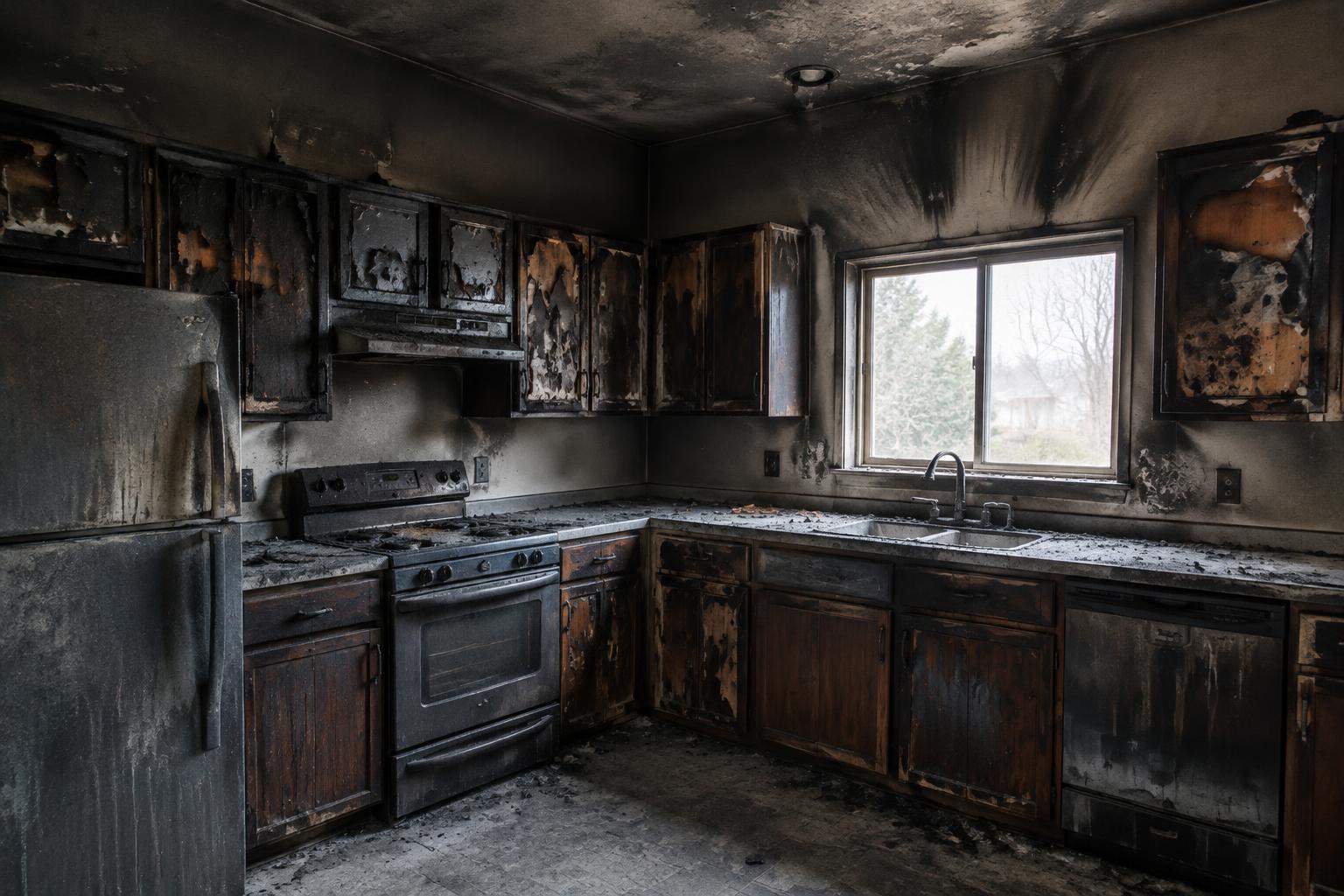
Charring is the easy part. Smoke travels through a building and keeps doing damage after the fire is out — corroding metal, staining surfaces, and settling into everything the air touched.
If you read nothing else
- 01Do not re-enter until the fire department says it is safe.
- 02Do not run the heat or the air conditioning.
- 03Photograph and list everything before it leaves the building.
The first hours, in order
The fire is out, the building is standing, and the damage is only starting. Soot is acidic and slightly oily. On metal it begins corroding within days. On walls it bonds. In the air it moves through every gap, duct and plumbing chase — which is why a room the flames never reached can still smell of smoke a month later.
- Do not go back in until the fire department has cleared the building. Structural damage, a gas leak and live circuits are not things you can judge from the doorway.
- Photograph every room before anything is moved or cleaned, including the rooms that look untouched. Open cabinets and closets and photograph inside them.
- Do not run the furnace or the air conditioning. Soot sitting in the ducts will be pushed into every room in the building.
- If the power is off, empty the refrigerator and freezer and prop the doors open. Food spoiling in a warm building becomes a second, separate odor problem.
- Board or cover openings if windows, doors or the roof are open, and ask your insurer about securing the property. Most policies expect you to protect the building from further damage.
- Keep every receipt — hotel, meals, laundry, a lock, a tarp. Additional living expenses are usually reimbursable, but only with receipts.
- If you have to be inside, wear respiratory protection and gloves. Do not spend hours in soot without it.
A fire is almost always a water loss as well. Hoses put a lot of water into a building, and the drying is part of the same job.
What makes it worse
Smoke residue is not dirt. Treating it like dirt is how it gets worked into the surfaces it has landed on.
- Do not wipe soot with a wet cloth or an all-purpose cleaner. Water and soot make a smear that sets into porous surfaces and pushes the smell deeper in.
- Do not use an ordinary vacuum or a broom. Fine soot goes straight back out into the air, into rooms that were clean.
- Do not use air fresheners, candles, or a machine bought online to cover the smell. It returns as soon as the masking agent is gone. Odor is a source problem.
- Do not eat food from the kitchen — including food in cans or jars that were exposed to heat — and do not use appliances whose wiring or gas line may have been affected.
- Do not wash clothing or textiles before they have been inventoried and photographed for the claim.
- Do not assume the damage stops at the room with the burn. Smoke follows the air, and the air went everywhere.
What smoke reaches that the fire does not
A fire is three separate problems in one building: what burned, what the smoke touched, and what the water did.
Smoke residue settles on horizontal surfaces first, then walls and vertical surfaces, then inside closets, drawers, cabinets and electronics. It works into upholstery, clothing, books, mattresses, and the back of the drywall in the room where the fire was worst.
The water is what makes it structural. Saturated drywall, soaked insulation and standing water in a basement all have to be dried on the same clock as any other water loss, and often the fire-damaged area has to be stabilized before it can be dried properly.
That is why the assessment has to look at all three, and why a fire job is scoped room by room rather than as one number.
A small kitchen fire with a working exhaust fan still puts smoke through a whole apartment. The room that smells is not always the room that burned.
What insurance usually covers, and what it often does not
Fire is the loss policies were written for, so this is usually the most straightforward claim of the four. The limits still exist, and they tend to be about what comes after the fire rather than the fire itself.
Usually covered
- The structure and the contents, generally on a replacement-cost basis if that is what the policy says.
- Smoke damage and water damage from extinguishing, as part of the same loss.
- Debris removal, board-up, and other work needed to protect the property from further damage.
- Additional living expenses — a hotel, meals above your normal grocery spend — up to a stated limit and usually for a stated period.
Often not covered
- Anything above the dwelling limit on the policy, which is why the rebuild number matters more than the market value of the house.
- Ordinance or code upgrades — a rebuild that has to meet current code where the old work did not. Some policies include a percentage; many do not.
- Asbestos or other hazardous material found during the tear-out, under many policies, unless there is pollution or ordinance cover. In a pre-1980 building that is a real line item.
- Landscaping, and often outbuildings, pools and fences, which sit under separate sublimits.
- A home business’s lost income, unless it was specifically endorsed.
The contents inventory is the part people underestimate. A room-by-room list with photographs, brand names and rough ages gets a very different response from a paragraph saying “contents, approximately”.
Do it yourself, or call us
Very little of a fire job is a do-it-yourself job. The part that genuinely is: the inventory and the receipts.
You can handle this
- A contained cooking fire — a pan, a toaster — with no water used, no charred building material and no smell beyond the kitchen.
- Washing hard, non-porous surfaces in a room the fire never reached, after the air has been cleaned.
- Making the room-by-room inventory and keeping the receipts. This is the most valuable thing you can do yourself.
Call instead
- Any fire beyond a contained cooking flare-up.
- Smoke smell in more than one room, or a smell that comes back after a week.
- Soot visible on walls, ceilings, or inside cabinets.
- Water from the hoses, or a wet ceiling below the floor where the fire was.
- Anything that means opening a wall or a ceiling in a pre-1980 building.
- A rental, a commercial space, or a building with more than one unit.
- An insurer asking for a scope, a report, or a contents inventory.
What happens from the first call
Stabilize, document, remove, clean, treat the air, and hand back a record.
- 01
You call and describe it
What burned, how large it was, how long ago, whether the fire department used water, and whether the building is secure. We tell you what not to do before we get there.
- 02
We assess all three damages
Char, smoke and water, room by room, including closets, ducts and cavities. A written scope, photographed throughout, in a form an adjuster can read.
- 03
We secure and stabilize it
Board-up, roof covering, water extraction and drying, so the building stops getting worse while the rest of the work is planned.
- 04
We remove what cannot be saved
Debris out, and the material that has to come out to reach smoke and water behind it. Older buildings are sampled for asbestos and lead before any of that starts.
- 05
We clean the soot and smoke
Dry removal first, then cleaning matched to each surface — wood, metal, plaster, fabric, electronics — with HEPA vacuuming throughout.
- 06
We deal with the odor
Source removal first, then treatment of the space itself. Some treatments require the building to be empty while they run, and we say so before anything starts.
- 07
Contents and closeout
Pack-out, inventory, cleaning and storage where it is needed, then a final walkthrough with the report and the inventory in your hand.
General guidance for Chicago-area buildings. It is not a substitute for an on-site assessment, a lab report, or a reading of your own policy.
Not sure where you stand?
Call for an assessment.
If the fire was this week, call today. What is left after the flames is the part that keeps costing money.
Open 24 hours, 7 days a week, including emergencies.